

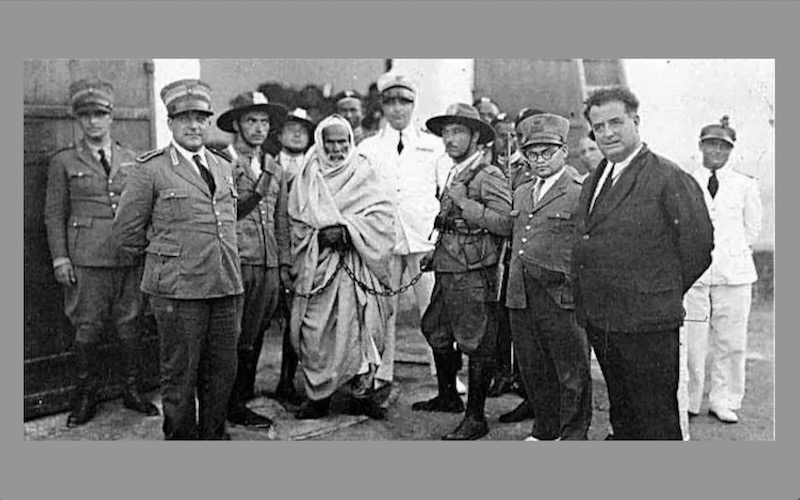
Above image: Shaykh Omar al-Mukhtar, aka. Lion of the Desert, born around 1860 in the village of Zawiyat Janfur, Libya, emerged as a symbol of resistance against Italian colonization as a respected teacher within the Senussi Sufi order. Shaykh Al-Mukhtar led and organized and led guerrilla warfare against the Italian forces. He famously said, “As for me, I will live longer than my hangman.”
How many of us have heard of this hadīth?
«رجعنا من الجهاد الأصغر إلى الجهاد الأكبر…»
“We’ve returned from the lesser jihad (the battle) to the greater jihad (the inner struggle)”
Or this one?
“الجنة تحت أقدام الأمهات.”
“Paradise is under the feet of mothers.”
How about this hadīth?
“إن أبواب الجنة تحت ظلال السيوف”
“The gates of heaven are under the shadow of the swords.”
Or this one?
“ذروة سنام الإسلام الجهاد في سبيل الله”
“The peak of Islam is jihad.”
Average Muslims maybe remarkably familiar with the first two, yet deeply unfamiliar, or perhaps even slight uncomfortable, with the last two. This discomfort is very telling. It is a sign that the way we relate to Islam is deeply bifurcated and by extension, compromised.
Whether or not every narration above reaches the same level of authenticity is beside the point. This thought experiment on hadīth familiarity reveals something profound about the contemporary constraints on Islamic discourse and Muslim moral imagination: on the one hand, there is a disproportionate emphasis on the inner struggle, on mercy, on service to one’s parents, which are all central and meritorious acts. However, due to the security state’s ultimate criminalization of any combination of Muslimness and resistance, talk of sacrifice and armed struggle are regarded as too dangerous, too corrosive, and thus, they are surgically removed from daily speech, seminaries, curricula and policymaking, as if they do not even exist at all in the Qur’an and sunnah. Islamically speaking however, kindness to one’s parents and confronting a soldier that is intent on stealing your house are not conceived as competing virtues. They form a single ethical universe. The false binary between the purification of the soul and the transformation of the world does not exist.
Nowhere is this tokenization, securitization, and appropriation of Islamic histories and vernaculars more evident than in our twin approaches to the domain of Sufism (ihsan/tazkiya/tassawuf) and Jihad.
The two domains have become civilizational opposites.
The “Sufi” who is devoted to God is imagined as more enlightened than average Muslims, he is viewed as harmless, apolitical, mystical, inward-looking. The “jihadi”, in contrast, is seen through the CVE lens; he is imagined as political, barbaric, illiberal militant, irrational, and inherently threatening.
One is the ultimate “good Muslim.” The other is the ultimate“bad Muslim.”
In Granada, I showed this slide:
The Colonial Calculus and the “War on Terror”
Islam + Jihad = “Extremism”
Sufism – Islam = “Moderation”
Islam minus (the core) authentic ihsan minus (the peak of verified faith in action) jihad=
What remains of faith, then? A skeleton, a shell?
Ihsan plus Jihad = restoring epistemic equilibrium/ the ultimate breaker of the madhakli/neo-traditionalism/CVE colonial calculus.
But this binary is neither Islamic nor historically accurate. It is colonially constructed.
In Formations of the Secular, Talal Asad argues that modern states do not simply regulate religious practices. They reshape the very conditions under which religion can be imagined and lived. He discusses how certain Islamic aspirations become acceptable—private piety, spirituality, individual ethics—while others become unintelligible or threatening: those such as alternative sovereignties, comprehensive ethical worlds, anti-colonial dissent, and ummatic imaginaries. Similarly, in Recalling the Caliphate, Salman Sayyid argues that colonialism and postcolonial secularism regulate Muslim political imagination itself. When we go to Muslim countries and see displays of “Muslimness” everywhere—whether in dress or landscapes—this is not in itself a sign of agency, rather, it is what kinds of Islam are permitted to exist. A heavily regulated Muslimness under a secular security apparatus that has a de facto monopoly on violence.
Nothing could be more catastrophic and indicative of intellectual colonization than when Muslims themselves internalize and operate upon the logic of the “war on terror.” This risks removing certain verses from the Qur’an and edicts deemed as untouchable, thus putting the health of one’s faith at risk: “Do you believe in some of the Scripture and reject the rest?” (Baqara: 85) Not only that, when one buys into the logic of an external force regulates which part of Islam is acceptable and which is rendered criminal, how can one actualize their relationship with their Creator? Their faith becomes not only crippled, but it aids and abets the apparatus that casts their undesirable brethren outside of the “approved”confines of the security state.
Let us remember that even the word Sufism itself is a colonial construction. Carl Ernst famously described it as a product of “Orientalist zoology”—a taxonomy that carved Islam into manageable species, classifying, domesticating, and isolating one dimension of the tradition from another. Muslims themselves eventually internalized these categories until “Sufism” became something separate from Islam instead of one of its deepest interior sciences and pathways to knowing God in the highest form.
The categorical severing of Sufism from the heart of Islam thus had a surgical, strategic aim.
As previously shown, let us remember that colonial campaigns first launched sustained campaigns against Sufi brotherhoods long before anti-Muslim Brotherhood polemics became widespread. European colonial administrations understood something that many contemporary observers have forgotten: Sufi orders were not merely circles of devotional remembrance, they were educational institutions, welfare networks, military organizations, political communities, and sovereign centers of authority.
Ironically, what today’s CVE discourse says about Hamas, Muslim Brotherhood and jihadis was once said about mullahs, khanqas, zawiyas and dervishes. The language of fanaticism, irrationality, and civilizational threat was first directed at Sufi brotherhoods leading anti-colonial resistance. Sufis were the “bad Muslims.” Yet, today, they are the quintessential “good Muslim.” Studies of Islamic mysticism continue to associate Sufism almost exclusively with poetry, literature, ecstatic practice, quietism, and pacifism, while rarely engaging questions of political reform, anti-colonial struggle, or revolutionary social transformation.
This historical amnesia matters now more than ever, as there exists an existential battle for the soul of Islam: I deeply believe this battle lies not between authenticity, orthodoxy or minute differences within intra-Muslim sects, schools or ideologies, but rather, between state-hijacked Islam and sovereign Islam. This is why you will find me on the side of principled Salafis over state-sponsored Sufis, and on the side of principled Sufi scholars over state-sponsored madkhalis any day. You will find me on the side of a courageous “Husseini” Sunni scholar over a meek “Safavid” Shi’i scholar who does nothing to enjoin ummatic conciseness, and vice versa.
In other words, the divider is not theological difference, rather it is political difference. Talk of sectarian, theological and ideological differences needs to become obsolete. The fault line of intra-Muslim must be the principled, Prophetic vision and the universal, ummatic ethic.
Frantz Fanon famously observed that decolonization is a violent phenomenon. Whether or not one agrees with every dimension of his analysis, the truth is that this “decolonization” process already has an Islamic legal category that is rarely uttered in Muslim societies: jihad. Brutal military subjugation, land theft and genocidal killing sprees are already dealt with legally as grounds for resistance. And these things will likely not be simply shooed away through unlimited real politcking, 4D chess pragmatism, interior purification or knowledge-seeking only alone.
The anti-colonial struggles of the nineteenth century—which were sometimes successful (in the immediate, worldly outcome sense) and sometimes not—repeatedly fused profound spiritual discipline with organized political resistance. This is evident also in the 20th century, in even the Palestinian struggle in the Great Revolt of 1936, which, we forget, was triggered by a Syrian Sufi scholar named Izzidin al-Qassam. I recently found an excerpt by the legendary Palestinian freedom fighter Bahjat Abu Gharbieh (d.2012) who led the historic Qastal battle alongside Abdul Qadir al-Husseini in 1948 and also fought against the British and Zionist colonial gangs in the 1936:
“I adopted the path of what can be called as-Sufi al-munadil “the resisting Sufi.”
What the Sufis have said left a deep imprint on my path, particularly the saying of the mystic Rabi’a who said of Divine love:
“I love You not out of greed for your reward, nor out of fear of Your punishment, but because You deserve love.”
And I believe that the Sufi fighter struggles not out of greed for bounty nor out of fear of sin, but because our stolen homeland deserves our love and deserves for us to sacrifice ourself for its sake.”
From his memoirs, Fī khidam al-nidāl al-‘arabī al-filastīnī, 1993